
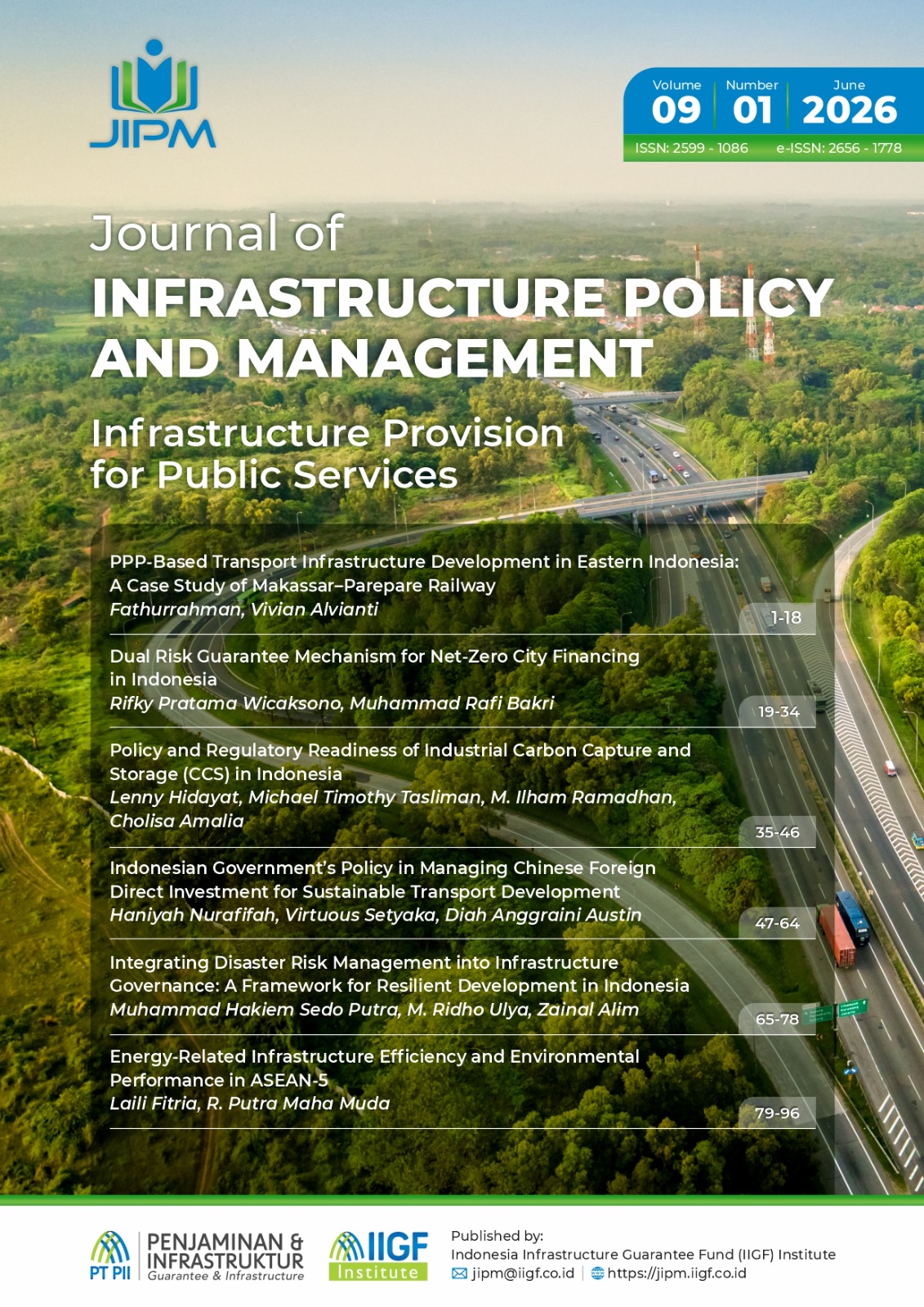
Energy-Related Infrastructure Efficiency and Environmental Performance in ASEAN-5
DOI:
https://doi.org/10.35166/jipm.v9i1.174Keywords:
ASEAN, environmental performance, infrastructure efficiency, panel regressionAbstract
This paper examines how infrastructure efficiency, proxied by GDP per unit of energy use, relates to environmental and economic factors in ASEAN-5 countries. The study covers Indonesia, Malaysia, the Philippines, Thailand, and Vietnam from 2010 to 2023, using annual data from the World Bank’s World Development Indicators. The empirical analysis applies pooled ordinary least squares, fixed-effects, and random-effects panel models, with the Hausman specification test to determine the preferred estimator. The regression sample is based on available country-year observations after accounting for missing data. The fixed-effects results show that carbon dioxide emissions per capita are negatively and significantly associated with infrastructure efficiency, while electricity consumption per capita is positively and significantly associated with it. GDP per capita and the renewable energy share have positive coefficients in the fixed-effects model, but these estimates are not statistically significant at conventional levels. Overall, the findings suggest that lower CO₂ emissions per capita and higher electricity consumption per capita are more consistently associated with infrastructure efficiency, while GDP per capita and renewable energy share show less robust statistical relationships in the present sample. These results highlight the importance of combining cleaner energy use with more productive energy systems.
References
Acheampong, A. O. (2018). Economic growth, CO₂ emissions and energy consumption: What causes what and where? Energy Economics, 74, 677–692. https://doi.org/10.1016/j.eneco.2018.07.022
Ang, J. B. (2008). Economic development, pollutant emissions and energy consumption in Malaysia. Journal of Policy Modeling, 30(2), 271–278. https://doi.org/10.1016/j.jpolmod.2007.04.010
Apergis, N., & Payne, J. E. (2010). Renewable energy consumption and growth in Eurasia. Energy Economics, 32(6), 1392–1397. https://doi.org/10.1016/j.eneco.2010.06.001
Arellano, M., & Bond, S. (1991). Some tests of specification for panel data: Monte Carlo evidence and an application to employment equations. The Review of Economic Studies, 58(2), 277–297. https://doi.org/10.2307/2297968
Baltagi, B. H. (2021). Econometric analysis of panel data (6th ed.). Springer. https://doi.org/10.1007/978-3-030-53953-5
Balsalobre-Lorente, D., Shahbaz, M., Roubaud, D., & Farhani, S. (2018). How economic growth, renewable electricity, and natural resources impact environmental quality. Energy Policy, 113, 182–195. https://doi.org/10.1016/j.enpol.2017.10.050
Destek, M. A., & Sinha, A. (2020). Renewable, non-renewable energy consumption, economic growth, trade openness and ecological footprint: Evidence from organisation for economic co-operation and development countries. Journal of Cleaner Production, 242, Article 118537. https://doi.org/10.1016/j.jclepro.2019.118537
Dogan, E., & Inglesi-Lotz, R. (2020). The impact of economic structure to the environmental Kuznets curve (EKC) hypothesis: Evidence from European countries. Environmental Science and Pollution Research, 27, 12717–12724. https://doi.org/10.1007/s11356-020-07878-2
Fitriyanto, F., & Iskandar, D. D. (2019). An analysis on determinants of energy intensity in ASEAN countries. Jurnal Ekonomi dan Studi Pembangunan, 11(1), 90–103. https://doi.org/10.17977/ um002v11i12019p090
Hausman, J. A. (1978). Specification tests in econometrics. Econometrica, 46(6), 1251–1271. https://doi.org/10.2307/1913827
Ilyas, M., Mu, Z., Akhtar, S., Hassan, H., Shahzad, K., Aslam, B., & Maqsood, S. (2024). Renewable energy, economic development, energy consumption and its impact on environmental quality: New evidence from South East Asian countries. Renewable Energy, 223, Article 119961. https://doi.org/10.1016/j.renene.2024.119961
Khuong, P. M., McKenna, R., & Fichtner, W. (2019). Multi-level decomposition of ASEAN urbanization effects on energy. International Journal of Energy Sector Management, 13(4), 1107–1132. https://doi.org/10.1108/IJESM-12-2018-0002
Kirikkaleli, D., & Adebayo, T. S. (2021). Do renewable energy consumption and financial development matter for environmental sustainability? New global evidence. Sustainable Development, 29(4), 583–594. https://doi.org/10.1002/sd.2159
Lean, H. H., & Smyth, R. (2010). CO₂ emissions, electricity consumption and output in ASEAN. Applied Energy, 87(6), 1858–1864. https://doi.org/10.1016/j.apenergy.2010.02.003
Munir, Q., Lean, H. H., & Smyth, R. (2020). CO₂ emissions, energy consumption and economic growth in the ASEAN-5 countries: A cross-sectional dependence approach. Energy Economics, 85, Article 104571. https://doi.org/10.1016/j.eneco.2019.104571
Nasreen, S., & Anwar, S. (2014). Causal relationship between trade openness, economic growth and energy consumption: A panel data analysis of Asian countries. Energy Policy, 69, 82–91. https://doi.org/ 10.1016/j.enpol.2014.02.009
Nathaniel, S. P., & Khan, S. A. R. (2020). The nexus between urbanization, renewable energy, trade, and ecological footprint in ASEAN countries. Journal of Cleaner Production, 272, Article 122709. https://doi.org/10.1016/j.jclepro.2020.122709
Saboori, B., Sulaiman, J., & Mohd, S. (2012). Economic growth and CO₂ emissions in Malaysia: A cointegration analysis of the environmental Kuznets curve. Energy Policy, 51, 184–191. https://doi.org/10.1016/j.enpol.2012.08.065
Sadorsky, P. (2009). Renewable energy consumption and income in emerging economies. Energy Policy, 37(10), 4021–4028. https://doi.org/10.1016/j.enpol.2009.05.005
Sadorsky, P. (2013). Do urbanization and industrialization affect energy intensity in developing countries? Energy Economics, 37, 52–59. https://doi.org/10.1016/j.eneco.2013.01.009
Sarkodie, S. A., & Strezov, V. (2019). Effect of foreign direct investments, economic development and energy consumption on greenhouse gas emissions. Science of the Total Environment, 646, 862–871. https://doi.org/10.1016/j.scitotenv.2018.07.365
Seto, K. C., Davis, S. J., Mitchell, R. B., Stokes, E. C., Unruh, G., & Ürge-Vorsatz, D. (2016). Carbon lock-in: Types, causes, and policy implications. Annual Review of Environment and Resources, 41, 425–452. https://doi.org/10.1146/annurev-environ-110615-085934
Stern, D. I. (2012). Modeling international trends in energy efficiency. Energy Economics, 34(6), 2200–2208. https://doi.org/10.1016/j.eneco.2012.03.009
Tran, T., Bui, H., Vo, A. T., & Vo, D. H. (2024). The role of renewable energy in the energy–growth–emission nexus in the ASEAN region. Energy, Sustainability and Society, 14, Article 17. https://doi.org/10.1186/s13705-024-00446-3
United Nations. (2001). Intensity of energy use. Division for Sustainable Development. https://www.un.org/ esa/sustdev/natlinfo/indicators/isdms2001/isd-ms2001economicB.htm
Unruh, G. C. (2000). Understanding carbon lock-in. Energy Policy, 28(12), 817–830. https://doi.org/ 10.1016/S0301-4215(00)00070-7
Voumik, L. C., Islam, M. A., Rahaman, A., & Rahman, M. M. (2022). Emissions of carbon dioxide from electricity production in ASEAN countries: GMM and quantile regression analysis. SN Business & Economics, 2, Article 133. https://doi.org/10.1007/s43546-022-00318-y
Wang, Q., & Su, M. (2020). Drivers of decoupling economic growth from carbon emission: An empirical analysis of 192 countries using decoupling model and decomposition method. Environmental Impact Assessment Review, 81, Article 106356. https://doi.org/10.1016/j.eiar.2019.106356
Wooldridge, J. M. (2010). Econometric analysis of cross section and panel data (2nd ed.). MIT Press.
World Bank. (2025a). World Development Indicators [Data set]. World Bank Open Data. https://databank.worldbank.org/source/world-development-indicators
World Bank. (2025b). GDP per unit of energy use (PPP $ per kg of oil equivalent) (EG.GDP.PUSE.KO.PP). World Development Indicators Metadata. https://databank.worldbank. org/metadataglossary/world-development-indicators/series/EG.GDP.PUSE.KO.PP
World Bank. (2025c). GDP per unit of energy use (constant 2021 PPP $ per kg of oil equivalent) (EG.GDP.PUSE.KO.PP.KD). World Development Indicators Metadata. https://databank.worldbank.org/metadataglossary/world-development-indicators/series/EG.GDP.PUSE.KO.PP.KD
Zhang, S., Worrell, E., & Crijns-Graus, W. (2015). Evaluating co-benefits of energy efficiency and air pollution abatement in China’s cement industry. Applied Energy, 147, 192–213. https://doi.org/ 10.1016/j.apenergy.2015.02.081
Downloads
Published
Issue
Section
License
Copyright (c) 2026 Journal of Infrastructure Policy and Management

This work is licensed under a Creative Commons Attribution-ShareAlike 4.0 International License.