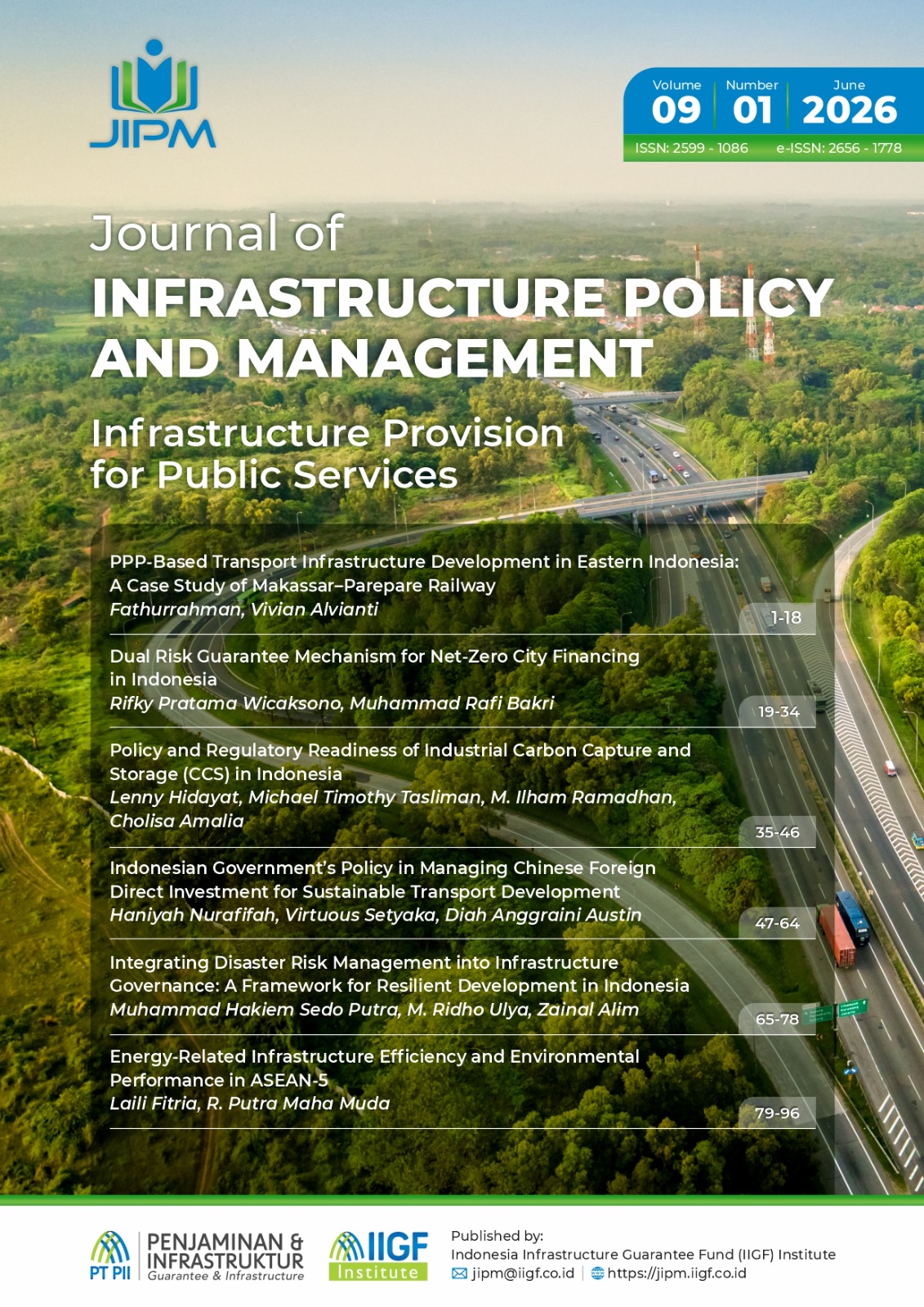
Indonesian Government’s Policy in Managing Chinese Foreign Direct Investment for Sustainable Transport Development
DOI:
https://doi.org/10.35166/jipm.v9i1.141Keywords:
Chinese Investment, FDI, SDGs, Transportation InfrastructureAbstract
Foreign Direct Investment (FDI) is one of the funding sources, alongside the State Budget (APBN), that can be used to support national development. This study aims to analyze the policies implemented by the Indonesian government to achieve adequate infrastructure development in accordance with the SDGs agenda, particularly transportation infrastructure that supports global sustainability by utilizing Chinese FDI as one of its funding sources. This study employs a qualitative approach with a descriptive research design. Primary data were obtained through interviews with the Ministry of Investment and Downstream Industry, while secondary data were collected from reports, journals, articles, and relevant websites. Using Theodore H. Moran’s concept of FDI and Development, this study analyzes how Indonesian government policies seek to achieve structural benefits in managing Chinese FDI in the transportation sector to support sustainable development. The findings show that the four main indicators of FDI and Development—transparency of payments, improvement of economic patterns, enhancement of the local business climate, and promotion of investment—have been implemented fairly well. Chinese FDI has contributed to technological transfer, skill upgrading, supporting industries, and improved investor confidence in Indonesia’s sustainable transportation development.
References
Abdussamad, Z. (2021). Metode penelitian kualitatif. Syakir Media Press.
Alamsyah, I. E. (2024, June 15). Produsen mobil China pastikan Indonesia jadi hub produksi EV stir kanan untuk 54 negara. Republika Online. https://ekonomi.republika.co.id/berita/sf3nnt349/produsen-mobil-china-pastikan-indonesia-jadi-hub-produksi-ev-stir-kanan-untuk-54-negara
Assagaf, S. R., Firdharizki, A., & Wisnumurti, H. (2023). China as an alternative source of FDI: Analyzing the cases in Indonesia. Ilomata International Journal of Social Science, 4(3), 508–517. https://doi.org/10.52728/ijss.v4i3.871
Badan Koordinasi Penanaman Modal Republik Indonesia. (2021). Peraturan Badan Koordinasi Penanaman Modal Republik Indonesia Nomor 4 Tahun 2021 tentang pedoman dan tata cara pelayanan perizinan berusaha berbasis risiko dan fasilitas penanaman modal. https://jdih-storage.bkpm.go.id/jdih/userfiles/documents/2021/10/2021PerBKPM004.pdf
Biro Komunikasi dan Informasi Publik. (2024, May 14). Kementerian Perhubungan telah selesaikan 25 proyek strategis nasional sektor transportasi. Kementerian Perhubungan Republik Indonesia. https://dephub.go.id/post/read/kementerian-perhubungan-telah-selesaikan-25-proyek-strategis-nasional-sektor-transportasi
Caria, S., & Ghinoi, S. (2025). Evolving and differentiated strategy? A network approach to understanding Chinese development finance. Review of African Political Economy. https://doi.org/10.62191/ ROAPE-2025-0022
Chiyemura, F., Shen, W., Burgess, M., Mulugetta, Y., & Wang, Y. (2023). A dynamic institutional analysis of China’s engagement with Africa’s renewable energy market. Environmental Politics, 32(7), 1140–1162. https://doi.org/10.1080/09644016.2023.2194773
Dang, H. L., & Nguyen, L. P. (2022). China’s “dual circulation” strategy: Urgent needs for greater economic self-reliance. International Journal of China Studies, 13(2), 215–236. https://ejournal.um.edu.my/index.php/IJCS/article/download/45500/15977/117153
Fall, F., Fialho, P., & Huang, T. (2024). Scaling-up infrastructure investment to strengthen sustainable development in Brazil (OECD Economics Department Working Papers No. 1790). OECD Publishing. https://doi.org/10.1787/47d65b26-en
Fu, Y., Supriyadi, A., & Wang, T. (2018). China’s outward FDI in Indonesia: Spatial patterns and determinants. Sustainability, 10(12), Article 4632. https://doi.org/10.3390/su10124632
Gallagher, K. S., & Qi, Q. (2021). Chinese overseas investment policy: Implications for climate change. Global Policy, 12(3), 260–272. https://doi.org/10.1111/1758-5899.12952
Investasi, K. (2025). Wawancara bersama Kementerian Investasi dan Hilirisasi (BKPM).
Kementerian Keuangan Republik Indonesia. (2025, May 26). Pemerintah Indonesia perkuat kerja sama ekonomi strategis dengan Tiongkok lewat dua memorandum baru. https://www.kemenkeu.go.id/ informasi-publik/publikasi/berita-utama/mou-indonesia-tiongkok-25-mei-25
Keohane, R. O. (1989). International institutions and state power: Essays in international relations theory. Westview Press.
Leipziger, D. (2016). The OECD Convention on Combating Bribery of Foreign Public Officials in International Business Transactions. In The corporate responsibility code book (3rd ed., pp. 307–329). Greenleaf Publishing. https://doi.org/10.9774/gleaf.9781783530670_18
Lu, K., & Biglaiser, G. (2020). The politics of Chinese foreign direct investment in the USA. Journal of Asian and African Studies, 55(2), 254–272. https://doi.org/10.1177/0021909619874816
Moran, T. H. (1998). Foreign direct investment and development: The new policy agenda for developing countries and economies in transition. Institute for International Economics.
Nasruddin, N., Radam, I. F., Mahyuni, M., Riadi, S., Hadi, I. K., Dewi, D. H., & Rahmawati, R. (2024). Sustainable transportation infrastructure development: Case study of Tanah Bumbu Regency. Jurnal Geografika: Geografi Lingkungan Lahan Basah, 5(1), 85–92. https://doi.org/10.20527/ jgp.v5i1.12790
Octorifadli, G. P., Puspitasari, A., & Azzqy, A. A. R. (2022). Kepentingan Tiongkok terhadap Indonesia melalui Belt and Road Initiative dalam pembangunan Kereta Cepat Jakarta-Bandung periode 2015–2020. Balcony, 5(2), 175–186. https://jom.fisip.budiluhur.ac.id/index.php/balcony/article/ view/261
Ofosu, G., & Sarpong, D. (2022). China in Africa: On the competing perspectives of the value of Sino-Africa business relationships. Journal of Economic Issues, 56(1), 137–157. https://doi.org/ 10.1080/00213624.2022.2020025
Onat, N. C., Kucukvar, M., Halog, A., & Cloutier, S. (2017). Systems thinking for life cycle sustainability assessment: A review of recent developments, applications, and future perspectives. Sustainability, 9(5), Article 706. https://doi.org/10.3390/su9050706
Palguna, I. D. G., Santosa, A. A. G. D. H., Shara, M. C. P., & Karunian, A. Y. (2024). The regulation impact of foreign ownership on the cooperation projects air transportation. BESTUUR, 12(1), 1–22. https://doi.org/10.20961/bestuur.v12i1.79217
Peraturan Menteri Koordinator Bidang Perekonomian Nomor 4 Tahun 2024. (2024). Tata cara penyampaian usulan, verifikasi, evaluasi, penetapan, pemantauan, dan pelaporan perubahan daftar proyek strategis nasional. https://peraturan.bpk.go.id/Details/315220
Prasetyo, K. C. (2024). Global South responses to China’s BRI projects: A case study of Jakarta-Bandung High-Speed Railway Project. Global South Review, 5(2), Article 7. https://doi.org/10.22146/ globalsouth.90951
Quer, D., Rienda, L., & Andreu, R. (2019). Chinese investments in Latin America: An analysis of host country determinants. Journal of Evolutionary Studies in Business, 4(2), 45–67. https://doi.org/ 10.1344/jesb2019.2.j060
Rahayu, J. T. (2019, November 14). Pelindo I gandeng Belanda-China garap fase 2 Pelabuhan Kuala Tanjung. ANTARA News Sumatera Utara. https://sumut.antaranews.com/berita/257799/pelindo-i-gandeng-belanda-china-garap-fase-2-pelabuhan-kuala-tanjung
Reuters. (2025, February 5). Chinese firms control around 75% of Indonesian nickel capacity, report finds. https://www.reuters.com/markets/commodities/chinese-firms-control-around-75-indonesian-nickel-capacity-report-finds-2025-02-05/
Rohim, H. A. A. (2024, January 29). Pembangunan infrastruktur dorong pertumbuhan ekonomi Indonesia. Kementerian Sekretariat Negara Republik Indonesia. https://www.setneg.go.id/baca/index/ pembangunan_infrastruktur_dorong_pertumbuhan_ekonomi_indonesia
Saraswati, N. M. V. (2020). Menilik perjanjian Indonesia-Cina dalam kerangka Belt and Road Initiative (BRI) dalam perspektif ketahanan nasional. Jurnal Lemhannas RI, 7(2), 55–72. https://doi.org/ 10.55960/jlri.v7i2.72
Sarmiento, P. (2023, September 1). Belt and Road takes ties to “next level”. China Daily Global. https://epaper.chinadaily.com.cn/a/202309/01/WS64f119f7a31020d7c67bc4a8.html
Shen, W. (2020). China’s role in Africa’s energy transition: A critical review of its intensity, institutions, and impacts. Energy Research & Social Science, 68, Article 101578. https://doi.org/10.1016/ j.erss.2020.101578
Simmons, B. A. (2022, January 11). Domestic policies and practices could increase social and ecological risks along the BRI: Insights from Indonesia. Boston University Global Development Policy Center. https://www.bu.edu/gdp/2022/01/11/domestic-policies-and-practices-could-increase-social-and-ecological-risks-along-the-bri-insights-from-indonesia/
Siwi, A. P. (2013). Bilateral free trade: Hubungan perdagangan Indonesia-China dalam kerangka ACFTA. Jurnal Analisis Hubungan Internasional, 2(3), 111–127.
Spencer, D. A. (2019). Economics and “bad” management: The limits to performativity. Cambridge Journal of Economics, 43(6), 1455–1472. https://doi.org/10.1093/cje/bez033
Undang-Undang Republik Indonesia Nomor 32 Tahun 2009 tentang Perlindungan dan Pengelolaan Lingkungan Hidup. (2009). https://peraturan.bpk.go.id/details/38771/uu-no-32-tahun-2009
UNEP. (2025). Sustainable infrastructure investment. https://www.unep.org/topics/finance-and-economic-transformations/transforming-economies/sustainable-infrastructure
United Nations Office for Project Services. (2019). The critical role of infrastructure for the Sustainable Development Goals. The Economist Intelligence Unit. https://content.unops.org/publications/The-critical-role-of-infrastructure-for-the-SDGs_EN.pdf
Woodbridge, M. (2015). From MDGs to SDGs: What are the Sustainable Development Goals? ICLEI Briefing Sheet: Urban Issues, 1(1), 1–4.
World Bank. (2021). World development report 2021: Data for better lives. https://doi.org/10.1596/978-1-4648-1600-0
Xiao, J. (2010). The ASEAN-China Investment Agreement: A regionalization of Chinese new BITs. Society of International Economic Law Working Paper No. 2010/10.
Downloads
Published
Issue
Section
License
Copyright (c) 2026 Journal of Infrastructure Policy and Management

This work is licensed under a Creative Commons Attribution-ShareAlike 4.0 International License.