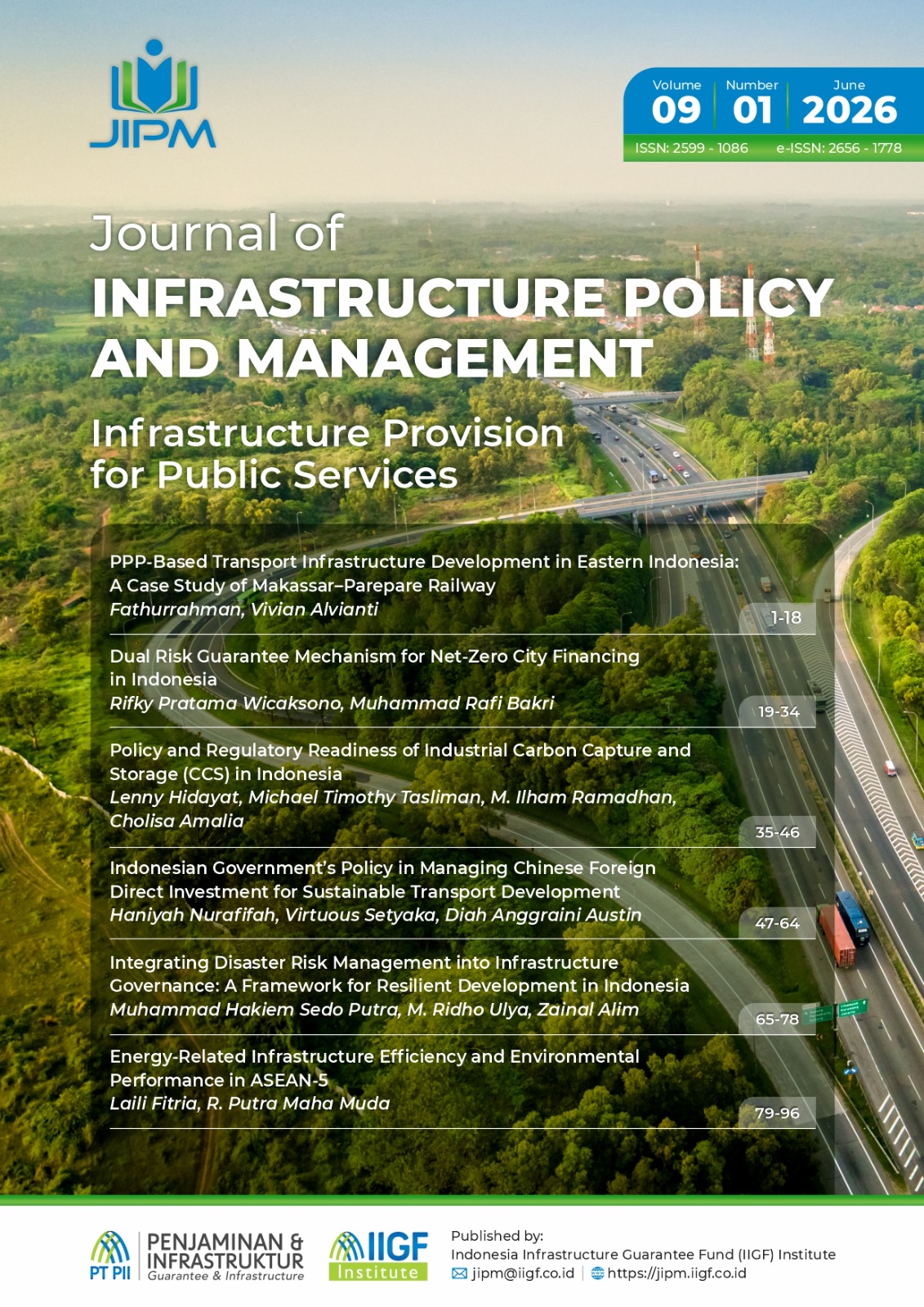
Integrating Disaster Risk Management into Infrastructure Governance: A Framework for Resilient Development in Indonesia
DOI:
https://doi.org/10.35166/jipm.v9i1.131Keywords:
Disaster Risk Management, Infrastructure Governance, ResilienceAbstract
Indonesia is highly vulnerable to disasters, e.g., floods, landslides, earthquakes, and volcanic eruptions; all of which pose serious risks to public infrastructure resilience. Although infrastructure investment continues to increase, disaster risk considerations are not fully integrated into infrastructure planning and governance. This study develops a conceptual framework for integrating Disaster Risk Management (DRM) into public infrastructure governance in Indonesia. Using secondary data from the National Disaster Management Agency, the Ministry of Public Works and Housing, and international development reports, the study applies a qualitative approach to examine policy frameworks, institutional arrangements, and the use of risk information in infrastructure planning. The findings show that infrastructure governance in Indonesia remains largely reactive, with limited use of hazard mapping in spatial planning and weak coordination among relevant institutions. The proposed framework emphasizes cross-sectoral coordination, systematic use of geospatial risk data, and community participation in planning and decision-making. Strengthening these mechanisms can enhance infrastructure resilience, reduce disaster-related losses, and support sustainable public infrastructure investment.
References
Abdillah, A., Widianingsih, I., Buchari, R. A., & Nurasa, H. (2025). Adapting to climate change and multi-risk governance: Toward sustainable adaptation and enhancing urban resilience—Indonesia. Discover Applied Sciences, 7, Article 81. https://doi.org/10.1007/s42452-025-06491-7
Bappenas [Badan Perencanaan Pembangunan Nasional]. (2024). Rencana Pembangunan Jangka Menengah Nasional (RPJMN) 2025–2029. Ministry of National Development Planning/National Development Planning Agency.
Chai, A., Wong, Y. S., Ong, S. A., Lutpi, N. A., Sam, S. T., Wirach, T., Kee, W. C., & Khoo, H. C. (2023). Exploring the potential of thermophilic anaerobic co-digestion between agro-industrial waste and water hyacinth: Operational performance, kinetic study and degradation pathway. Bioprocess and Biosystems Engineering, 46(7), 995–1009. https://doi.org/10.1007/s00449-023-02879-0
Darmawan, M., Sutrisno, D., Dewi, C., & Setiyawan, I. E. (2021). The integration of regional spatial planning (RTRW) and coastal spatial planning (RZWP3K) for the sustainable coastal area development. IOP Conference Series: Earth and Environmental Science, 750(1), Article 012052. https://doi.org/10.1088/1755-1315/750/1/012052
Davies, D. (2023). The broken promise of infrastructure. Lawrence & Wishart.
Edjossan-Sossou, A. M., Vuillet, M., Mehdizadeh, R., & Deck, O. (2020). Agent-based model for simulating households’ self-evacuation decision in high-rise buildings under critical infrastructure failures induced by a slow-onset flood conditions: A case study in Paris. IDRiM Journal, 10(2). https://doi.org/10.5595/001c.18160
Fadillah, I., Apriani, K., Hazlin, I. S., Mawadah, S. S. R., Siringoringo, S. E. M., Ulya, M. R., & Putra, M. H. S. (2025). Waste power plant as an innovative solution to overcome air pollution in Bantargebang Integrated Waste Management Facility. Applied Research in Science and Technology, 5(1), 86–96. https://doi.org/10.33292/areste.v5i1.72
Monstadt, J., & Coutard, O. (2019). Cities in an era of interfacing infrastructures: Politics and spatialities of the urban nexus. Urban Studies, 56(11), 2191–2206. https://doi.org/10.1177/0042098019833907
Moraitis, G., Nikolopoulos, D., Bouziotas, D., Lykou, A., Karavokiros, G., & Makropoulos, C. (2020). Quantifying failure for critical water infrastructures under cyber-physical threats. Journal of Environmental Engineering, 146(9), Article 04020108. https://doi.org/10.1061/(ASCE)EE.1943-7870.0001765
Napitupulu, R. T., & Putra, M. H. S. (2024). Pengaruh BOD, COD dan DO terhadap lingkungan dalam penentuan kualitas air bersih di Sungai Pesanggrahan. CIVeng: Jurnal Teknik Sipil dan Lingkungan, 5(2), 79–82. https://doi.org/10.30595/civeng.v5i2.17878
Pattharaprachayakul, N., Kesonlam, N., Duangjumpa, P., & Rungsardthong, V. (2021). Optimization of hydraulic retention time and organic loading rate in anaerobic digestion of squeezed pineapple liquid wastes for biogas production. Applied Environmental Research, 14(3), 468–476. https://doi.org/ 10.14416/j.asep.2021.04.004
Prameswara, G., Setyorini, D., Dahlan, M., Pradana, I., Assegaf, A., & Raihan, A. Z. (2024). Pelatihan pengolahan air yang berkelanjutan di Desa Pasiang, Polewali Mandar. Journal of Community Services and Sustainability, 2(2), 26–36. https://doi.org/10.52330/jocss.v2i2.374
Putra, M. H. S., Annisa, G. O. N., Mashuri, M., & Mardika, M. G. I. (2021). Pemetaan daerah sebaran banjir di hilir Tanggul Way Bulok Desa Sukamara Kecamatan Bulok Kabupaten Tanggamus Provinsi Lampung. TeknoKreatif: Jurnal Pengabdian Kepada Masyarakat, 1(2), 71–81. https://doi.org/ 10.35472/teknokreatif.v1i2.498
Putra, M. H. S. (2023). Potential of the rainwater harvesting method in fulfilling domestic water needs at SD Negeri 02 Gunung Terang Bandar Lampung. Jurnal Teknik Sipil, 19(1), 1–11. https://doi.org/ 10.28932/jts.v19i1.5112
Putra, M. H. S. (2025). Analisa komposisi sampah yang dihasilkan berdasarkan sifat dan karakternya di Kampus Institut Teknologi Sumatera 2023. CIVeng: Jurnal Teknik Sipil dan Lingkungan, 6(1), 13–18. https://doi.org/10.30595/civeng.v6i1.24156
Putra, M. H. S., Syahjoko Saputra, I., & Studi Rekayasa Tata Kelola Air Terpadu, P. (2025). Pemilihan sampah di ITERA 2023: Membangun budaya lingkungan bersih dan berkelanjutan. TeknoKreatif: Jurnal Pengabdian Kepada Masyarakat, 5(1), 13–21. https://doi.org/10.35472/ teknokreatif.v5i1.2118
Röhl, T. (2019). Making failure public: Communicating breakdowns of public infrastructures. In M. Korn, W. Reißmann, T. Röhl, & D. Sittler (Eds.), Infrastructuring publics (pp. 207–224). Springer Fachmedien Wiesbaden.
Rossi, S., Casagli, F., Sánchez-Quintero, Á., Leca, M.-A., Bennici, S., Limousy, L., Monlau, F., & Beigbeder, J.-B. (2023). Treatment and valorization of agro-industrial anaerobic digestate using activated carbon followed by Spirulina platensis cultivation. Sustainability, 15(5), Article 4571. https://doi.org/10.3390/su15054571
Sagala, S., Lassa, J., Yasaditama, H., & Hudalah, D. (2013). The evolution of risk and vulnerability in greater Jakarta: Contesting government policy in dealing with a megacity’s exposure to flooding. An academic response to Jakarta floods in January 2013. Working Paper of IRGSC, 1–18. https://www.researchgate.net/publication/261805526_The_evolution_of_risk_and_vulnerability_in_Greater_Jakarta_contesting_government_policy
Scano, E. A., Grosso, M., Pistis, A., Carboni, G., & Cocco, D. (2021). An in-depth analysis of biogas production from locally agro-industrial by-products and residues: An Italian case. Renewable Energy, 179, 308–318. https://doi.org/10.1016/j.renene.2021.07.050
Siagian, D. E. N., & Putra, M. H. S. (2024). Serat alam sebagai bahan komposit ramah lingkungan. CIVeng: Jurnal Teknik Sipil dan Lingkungan, 5(1), 55–60. https://doi.org/10.30595/civeng.v5i1.17879
Stantis, C., Serna, A., Verostick, K., Tipple, B., Jefferson, A., & Bowen, G. J. (2024). Isotopic heterogeneity in US urban water supply systems reflects climatic, environmental, and sociodemographic factors: Implications for forensic identification. Plos One, 19(11), Article e0311741. https://doi.org/10.1371/ journal.pone.0311741
Wakhungu, M. J., Abdel-Mottaleb, N., Wells, E. C., & Zhang, Q. (2021). Geospatial vulnerability framework for identifying water infrastructure inequalities. Journal of Environmental Engineering, 147(9), Article 04021034. https://doi.org/10.1061/(ASCE)EE.1943-7870.0001903
Downloads
Published
Issue
Section
License
Copyright (c) 2026 Journal of Infrastructure Policy and Management

This work is licensed under a Creative Commons Attribution-ShareAlike 4.0 International License.